Start Here: Introducing Parallel Perspectives
Parallel Perspectives | A PD Collective Blog Series
The Purpose & Power of Perspective
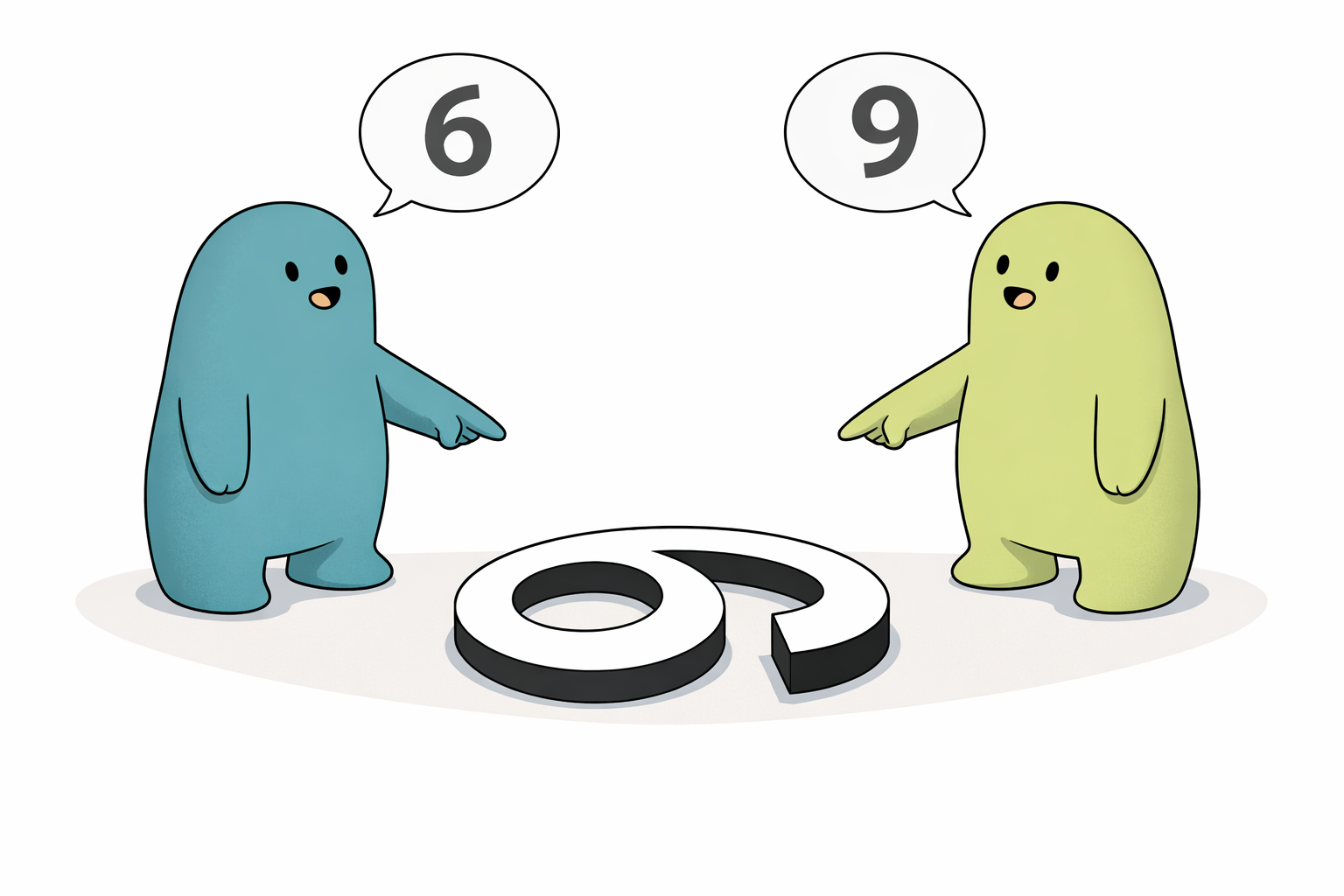
Look at the image above.
What do you see?
A six? A nine? A letter G if you’re feeling creative?
Of the two figures pictured, who is wrong?
No one!
They’re standing in different places, looking at the same thing, and making sense of what they see from where they stand. Neither perspective is inherently dishonest or unreasonable. Both are telling the truth about what they see.
And yet — this is the exact moment where things can begin to unravel. Where we can plant our heels in, holding firm to our “6” or “9”. Where we become convinced that what that other individual is seeing simply doesn’t exist. Or determined to convince someone that our number is the right one. Exerting our energy in an attempt to drag them over to our number instead of walking over to see theirs.
Professional Dangerousness (PD) thrives here.
Not in moments of outright conflict or obvious misstep — but in this quieter territory. The place where we’ve stopped entertaining the possibility that someone else’s view of the same thing might be just as real as ours.
This blog series lives in that territory.
And this post is where it starts.
Welcome to Parallel Perspectives
If you’ve landed here before — welcome back. If you’re new, we’re glad you’re here.
Parallel Perspectives is a blog series from the PD Collective, created around a simple but important premise: two people can experience the same dangerous pattern in completely different ways — and both experiences are worth considering. Because Professional Dangerousness doesn’t have one face. It wears ours.
The PD Collective is a collaborative venture between Jess and Brë — two former social workers, navigating the same work from two entirely different vantage points. We are, in the most literal sense, the 6 and the 9.
Each edition of Parallel Perspectives explores a specific expression of PD through our two distinct lenses. Grounded in recognizable narratives from the research, woven with honest storytelling about how that pattern surfaced for each of us in practice. Every edition closes with a reflection to help you examine your own lens, and what it might be bringing into the room with you.
PD Thrives in Assumptions
Here’s what we’ve come to understand: one of the most common — and least visible — entry points for Professional Dangerousness isn’t a dramatic failure of care.
It’s something more subtle– Sneakier.
It’s the moment we stop taking perspective and begin operating from assumption.
“Perspectives are a function of experience.” — Brené Brown
We don’t move through this world as neutral observers. We interpret it through the meaning we’ve made of everything that came before — the relationships we’ve had, the environments we’ve navigated, the lessons we’ve learned, and the beliefs we’ve built along the way. Our perspectives are shaped by thousands of things that happened to us long before we ever walked into a professional role.
That’s not a flaw. It’s deeply human.
But it becomes dangerous in practice when we lose sight of the fact that it’s a lens at all. When we begin treating our interpretation of the world as the world itself — and start measuring everyone else against it without realizing we’re doing it.
Nowhere does this surface more than in our values.
We may share the same values while holding very different beliefs about how those values ought to be expressed. What they should look like in others. What it signals when someone doesn’t demonstrate them the way we expect.
And when someone doesn’t — we rarely find ourselves thinking: different interpretation. Rather, we often assume: missing value.
That’s where PD gains its footing. Not necessarily in what we intend, but in what we assume. And those assumptions can color how we see people, how we respond to them, and ultimately how we practice — long before we recognize they’re operating at all.
Reflective Activity:
The Values Beneath Our Perspectives
Take a moment to pause and think about your values— the things you navigate your life by.
The qualities you look for in others when you're building relationships. The principles that, when violated, feel like a genuine breach.
They might be things like Trust, Communication, Respect, Justice, Family, Loyalty, Integrity, Safety, etc.
Write down as many as come to mind
Now look at that list.
Consider your beliefs about your values
How do you carry them? How are they lived out through you? What does it look like when someone honors them? What does it feel like when someone doesn’t?
Choose one or two values and consider:
What does this value mean to me?
How do I demonstrate it in my own life?
What do I expect it to look like in other people?
What happens inside me when someone doesn't express this value in the way I expect?
Where might those expectations have come from?
Parallel Perspectives: The 6 & 9
We often joke that in the visual above, Jess is most certainly the 6, and Brë is confidently the 9. This shows up regularly in our work together and, unsurprisingly, in our values as well.
Take trust. Picture it as the figure standing between us — the same number, viewed from opposite ends.
Jess’ 6 is what we lovingly refer to as a frontloader. She gives trust freely and immediately — extended at the door, yours until you break it. And even if you do break it, she believes wholeheartedly in its renewal, that everyone is worthy of the chance to rebuild it. That’s how she’s wired. And it’s very much a function of her experience.
Brë’s 9 is built differently. Her trust is a slow burn — intentional, incremental, earned. She will walk you through what she describes as a series of comprehensive, undisclosed assessments before she begins releasing pieces of herself. She’s not withholding. She’s discerning. There is a difference. Where Jess opens the door immediately and generously, Brë requires a password and issues a probationary visitor’s badge — she is what we call a check and verify. Evidence accumulates over time before trust is fully extended, and she monitors it carefully even after it’s given.
Same value. Entirely different architecture.
When we don’t take time to understand another person’s relational architecture — the history that built it, the logic it runs on — we can inadvertently introduce fracture into the very dynamics we’re trying to cultivate. Assumption moves in where curiosity should live. Where the frontloader could start to read caution instead as coldness, or worse, as distrust directed at them personally. The slow-builder starts reading openness as naivety, or an absence of discernment. Where different imperceptibly becomes wrong.
Common Ground
Each of us carries our own constellation of values — and many of them overlap. We often share the same words on our lists. But each value is lived out in our own image, filtered through our own history, expressed in our own particular way.
Regardless of how we carry our values, it is our responsibility to know them — the layers within them, the beliefs woven through them, the experiences that forged them — because they are quietly driving our practice whether we’re paying attention or not.
The work in human services asks something specific of us: not that we abandon our perspective, but that we remain willing to walk over and consider someone else’s. To recognize that our version of a value is not its definition. That our read on a behavior is one interpretation — not the verdict.
The 6 and the 9 aren’t a problem to be solved.
They’re a reminder that where we stand determines what we see — and that the most vital question we can carry into this work isn’t am I right?
It’s why do you see what you see?
Only by sitting inside that question do we create the conditions for the kind of understanding that genuinely serves the people in front of us — not the kind that confirms what we already believed, but the kind that stays curious about what we haven’t yet seen.
That’s what this series is built on.
Edition by edition, we’ll keep bringing you back to the number in the middle — and to the question of what you see when you look at it, and why.
A Few Things to Sit With
Return to your values list — or make one now if you haven’t yet.
1. Choose one value. How do you carry it? What does it look like in you, day to day? Now think of someone who seems to share that value but expresses it differently. What did you initially assume that difference meant?
2. Think of a recent moment in your work when someone’s behavior activated something in you. What meaning did you assign to it? What might you learn by getting curious about what shaped their behavior — rather than stopping at the behavior itself?
3. Where in your practice might your version of a value be quietly operating as the standard — and whose experience might that be invisibly measuring?
We’re not asking you to abandon your 6.
We’re asking you to wonder about the 9.
© 2025 The PD Collective. All rights reserved.